
IP Marketing Mindsets I Used to Build TikTok Awards Vietnam (2020-2023)
- sharewithjasmine
- Jul 31, 2025
- 13 min read

For nearly 15 years in this profession, there's one question that has always preoccupied me: Will our work truly leave anything behind, long after the KPIs are met and brilliant campaigns are forgotten? Perhaps every marketer has stood at a silent crossroads: on one side, the pressure to prove immediate results with numbers that sweep us away; on the other, the aspiration to contribute deeper, long-term value to the brand-a goal that feels both immensely pressuring and a luxury.
We often call this the battle between “tactics” and “strategy.”
My journey to TikTok was an attempt to find the answer to that very struggle. The difference lies in the mindset you adopt and the path you choose; it’s not found in textbooks but discovered through real-world challenges.
I was fortunate enough to be the one who laid the first bricks for TikTok Awards Vietnam, taking it from a concept on paper to a tangible reality, creating a valuable IP with a lasting legacy even after my departure. The story I'm sharing is the in-the-trenches journey of myself and my team - a journey of transforming marketing from a department seen as a "cost center" into a value creation engine during my years with the TikTok Vietnam marketing team, all starting with an idea called TikTok Awards.
To make it easier to follow, I've structured this story by context, problem, solution, and results.
Context & Challenges
When I joined TikTok Vietnam in 2020 as Head of Marketing of TikTok Vietnam, my first feeling was bewilderment at the startup environment after many years of working in corporations. TikTok Vietnam had no General Manager or Country Manager; departments operated in vertical silos, reporting directly to the region. The pace was incredibly fast, with OKRs set and changed every two months, creating immense pressure for immediate results. Marketing activities were short-term, and the budget was tight. The big plus side was the environment filled with young, dynamic, and open-minded colleagues.
In such an OKR-driven environment, it's easy to get sucked into the vortex of executing short-term, fragmented activities. I knew that to make a real difference and to establish the true value of my marketing mindset, I had to take a step back and look at the bigger picture instead of just focusing on the immediate tasks. Instead of being just an executor, a marketer must become a strategist, analyzing the organization's weaknesses (fragmentation, a superficial or even negative brand perception), market opportunities (a creative community eager to contribute and be recognized), and external threats (the indifference of potential user groups).
A breakthrough doesn't come from doing an old thing better; it comes from daring to do something entirely new. This is when I faced three strategic challenges:
From a newcomer's perspective: How could I meet the team's bi-monthly OKRs, build trust within the organization, and still have the energy to think about long-term strategy?
From a marketing perspective: How could I create sustainable marketing value that transcended fragmented bi-monthly activities and had a lasting impact on the TikTok brand?
From a leadership perspective: How could I build trust and unite siloed departments to foster a true "One TikTok Team" spirit?
Finding the answers to these big questions was a highly compressed process under immense pressure, taking place over just five months after I on-boarded in July 2020, amidst an unstable marketing team, bi-monthly OKRs, and a new culture and people. This context practically forced me to think independently from the idea of planning to get approval, then share and work with other departments to launch the first-ever TikTok Awards Vietnam in December 2020, just before the COVID-19 pandemic hit Vietnam hard and halted offline activities. I believe that work experience truly changed my way of working, demanding flexibility, agility, and the ability to combine thinking, planning, and execution simultaneously under tight deadlines.
Problem Analysis & Sourcing the Idea from Insights
My days at Unilever taught me a very effective working principle: "Never invent the new wheel." Simply put, when starting a task, we should pause to analyze and see what can be inherited from the organization or system before thinking of creating something new. While still executing the bi-monthly OKRs, I searched for materials and found that the Douyin platform in China had a large annual event for creators called Douyin Night, and a document from a former colleague proposed a TikTok Awards based on a subscription and follower model like another long-form platform. From these materials, I began to analyze several factors: 1. the target audience whose perceptions and behaviors I needed to change, 2. the platform's internal state (brand awareness, user numbers, creator quantity and quality, content types), 3. resources (marketing budget, resources from related departments), 4. the level of collaboration among leaders, 5. support from the regional marketing leadership, 6. the suitability of the timing, and 7. the risks I might face in a worst-case scenario. After analyzing these factors, I started planning.
The design of TTA didn't start from a lofty idea; the first thing I did was to find insights by listening to the two deepest sentiments at the time.
First, the voice of the non-users whom TikTok wanted to win over:
"I want to find an online space with deep, trustworthy content that aligns with my life's interests. But in my mind back then, TikTok was just full of silly, pointless lip-syncing and dancing videos by young people. I saw nothing there for me and felt the platform was rather 'shallow.' So, if there was a story about an ordinary person with a relatable topic that touched my life being told on TikTok, perhaps I'd be curious enough to check it out. I need a reason to believe this platform has depth."
In parallel, there was the concern of the dedicated content creators, the soul of the platform:
"I want to pour my heart into creating truly high-quality, valuable content—videos that not only entertain but also share knowledge and spread positive energy. But amidst a 'sea' of short-form entertainment, my efforts to create in-depth videos sometimes feel like a drop in the ocean, unseen and unsupported by the platform to grow. Therefore, I crave official recognition, a stage where my story and dedication are celebrated. I want to feel that my efforts are not just soulless numbers, but are contributing to a larger, more meaningful, and valuable TikTok community."
TikTok Awards was born to answer both of these concerns. It had to be a bridge connecting two shores: showing outsiders the platform's depth while making insiders feel valued. At the same time, back in 2020, TikTok Awards was also one of the first official large-scale events for TikTok in Vietnam. From a leadership perspective, this was a campaign where multiple departments could share and achieve common goals. Most importantly, the idea received recognition, strategic support, and budget from the regional marketing team. I'll always remember the words of my direct boss when he gave feedback on the idea: "Let TikTok Awards Vietnam be a place where the stories of small people can raise their voices through the creative values they have built with TikTok."
This is the act of creating marketing's "consumer surplus" for both external and internal customers, generating brand love from sincere empathy.
Let me explain this mindset a bit more clearly. In academia and strategic management, Intellectual Property (IP) Marketing is not defined as a separate branch of marketing, but as an interdisciplinary strategic approach. It's where IP assets are seen as the nucleus for creating value and competitive advantage, rather than just legal tools for defense. IP Marketing is not just about marketing a product; it's about transforming a brand's activities, events, or stories into a valuable 'Intellectual Property Asset.' This asset has its own life, capable of building its own community, driving its own virality, and even generating its own revenue. It's a strategic process of identifying, managing, and leveraging an organization's IP (like trademarks, copyrights, patents, designs) to build brand equity, create new revenue streams, and strengthen stakeholder relationships. Instead of just a short-term campaign, we are building a legacy that can be leveraged for the long haul. In essence, this mindset has three layers:
Foundation: Robustly identifying and protecting the IP.
Strategy: Integrating the IP portfolio into the overall business and marketing strategy, identifying which IPs have the greatest commercial potential.
Commercialization: Executing activities to turn that potential into real value, including licensing, franchising, merchandising, co-branding, and content development.
Action & Execution: Turning an idea into a "One TikTok" collective battle
I'll divide this part into two phases: the execution phase (making it happen) and the growth phase (scaling up).
Phase 1: Building the "One TikTok Team" Project & The Zero-Cost Media Explosion (2020)
Even a perfect blueprint will fail if the builders don't talk to each other. From the very beginning, I determined that TTA had to be a "One TikTok" campaign. I proactively shared the detailed plan with the leaders of other departments—Operations, PR, GR, GBS—turning TTA into a rallying point where all departments could work towards a common goal. This wasn't just simple coordination; it was a high-level exercise in stakeholder management. A marketing strategy is only truly successful when it creates value and gains consensus from all core stakeholders. If marketing initiates the idea and plans the journey for the team, then the Operations team is the soul of the platform; they maintain the connection between the platform, creators, and MCN partners. They had to be the first to be inspired by this IP's existence and its community spirit. TikTok Awards Vietnam was also a place for the GR team to connect with the government, for the Global Comms team to connect with media units, and for the commercial teams (GBS, GBM) to leverage. And truly, during my work with this IP, I collaborated extensively with the Legal team to ensure compliance and legal protection for the TikTok Awards IP. That's why, from the start, you could see that TikTok Awards Vietnam was different from other TikTok Awards in the region—it was a campaign built on the consensus of all department heads, a culturally impactful event from a media perspective. It wasn't an isolated activity of marketing or operations; it was a place to connect and deliver value to media partners and government agencies, and a place for TikTok to prove its positive impact. That's why, from the moment this brainchild was born, it carried so much value, meaning, and a marketer's pride that is hard to describe in words. The execution process demanded immense dedication. My agency and I made numerous direct calls to listen to the stories of inspiring creators at the time, like Việt Mỹ, Angela Tường Vy, Thành Ý, and Sô Y Tiết. We designed every invitation card, wrote every line of copy. Everything was done hands-on. In parallel, we talked with media partners about value-exchange collaborations, asking for every article, every TV broadcast slot.
Result: In 2020, TTA Vietnam became one of the top 5 most viral events in December (Buzz Metrics report) with zero dollars spent on paid media. By sharing meaningful stories and with the effort of the entire TikTok team to connect artists, guests, and media partners for multimedia channels spreading, we turned millions of users from passive viewers into proactive ambassadors, all on an operational budget so low you would find it hard to believe.
Phase 2: Commercializing the IP and Proving Business Value (2022-2023)
This was the final step in fulfilling the architect's role: proving value in the language of business. In 2021, I proposed a model called "Marketing IP Monetization." The core of this model came from a deep insight: the TikTok brand itself is a colossal asset. With its youthful, dynamic personality and its ability to lead the Gen Z and Millennial communities, TikTok possesses an influence that other brands crave but find very difficult to build on their own. Therefore, partnering with a TikTok Marketing IP would be a shortcut for brands to immediately generate buzz and a strong viral effect among this valuable user base. At this point, Marketing's role evolves from mere promotion to becoming a creator of "Marketing Blockbusters." We proactively created a common playground where TikTok and brands could collaborate through custom-designed "give/get packages," ensuring a win-win situation. Of course, no path is paved with roses. When you propose a new working model, the first thing you encounter is skepticism. No one believed marketing could "sell." So, I had to prove it myself. I had to personally pitch each IP to brands alongside the GBS team, and the first fruits of our labor appeared with collaborations from the GBM & GBS teams, including TikTok FashUp 2021 and the TikTok Film Contest 2021. The groundwork laid in 2021 with these IPs created the foundation for commercializing TikTok Awards Vietnam in the following years. I still remember when we were running TikTok Awards Vietnam 2022, we only had 55 days to prepare. That year, we began to monetize TTA with two main sponsors with value approx. 200,000 USD, together with 5 product sponsors, and 12 media partners barter partnership with value approx. 250,000 USD. All of these partners were managed by a very lean team of just two people. As a result, there were times I had to personally message brand founders to ask for sponsorship of every flower bouquet, every gift, every media post. I was not hesitant to do anything, as long as it was for the common goal and I could do it myself. This effort was not only to sustain TikTok Awards into its second year on a larger scale on a tight regional budget but also an attempt to keep a one-year-old IP alive.
Result: That persistence paid off. By the third year, we had turned this IP into a revenue machine with campaign sponsorship packages, including ads, valued at nearly 1 million USD with 10 main cash sponsors, 2 SMB sponsors & 14 product, venue, media partnership with value approx. 350,000 USD. This proved that creating TikTok IPs capable of connecting with brands that share a target audience and brand matching could generate immense commercial value.
A Few Lessons I Learned from the TikTok Awards Journey:
Lessons on Marketing
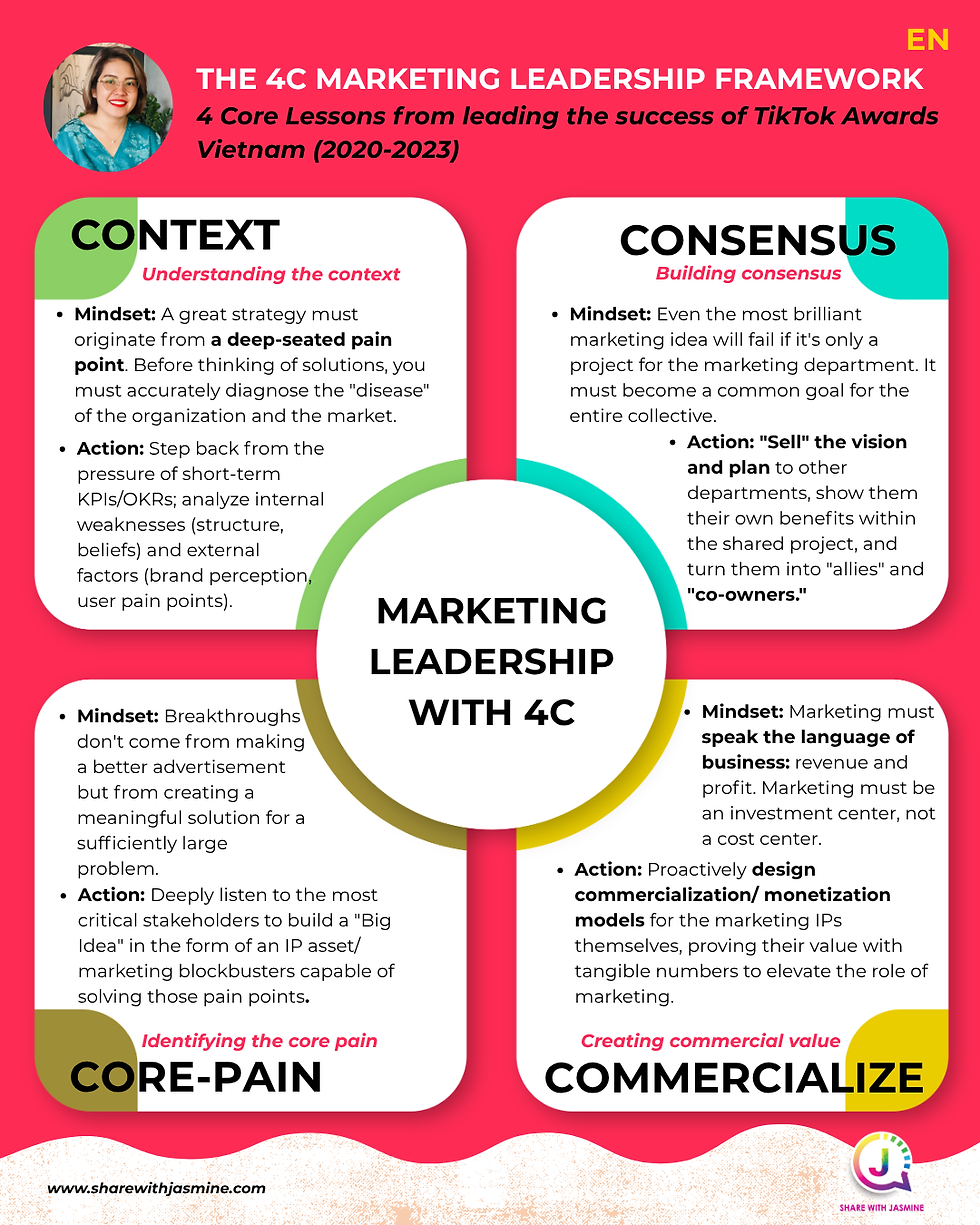
Amidst the operational vortex and chaotic OKRs/KPIs, take a step back to observe and analyze before acting. Breakthroughs don't come from running faster, but from daring to pause and see further.
Listen to the real pain points of customers & the organization to find the "blockbuster" idea. An idea, no matter how flashy, will be hollow if it doesn't solve a real problem. TikTok Awards succeeded because it wasn't just an event; it was a strategic "bridge" connecting two divides: on one side, the negative perception of non-users, and on the other, the creators' deep yearning for recognition. True marketing value is created when it solves the pain points of multiple stakeholders simultaneously.
Adopt an "asset" mindset over a "campaign" mindset. I learned to shift my perspective: not to create a "campaign" only to be forgotten, but to build an "asset" (IP) with its own life, story, community, and legacy. An asset can be nurtured, developed, and even generate its own revenue for years, completely redefining the role of marketing within an organization.
Lessons on Leadership
Genuine, value-based connection is the leadership philosophy I pursue. When entering a fragmented organization, a leader's role isn't just to lead their own team, but to become the "glue" that binds the entire machine together.
A vision must touch the heart, not just the numbers. A great leader doesn't just issue KPIs; they give the team a greater purpose, a meaningful story to believe in and strive for.
Focus, concentrate, and be meticulous with details from planning to execution. I believe no task is too small on the journey of creating something great. That is the only way to ignite passion and build a team that fights with all its heart.
Lessons on Personal Management
"Run" fast enough to deliver, yet be composed enough to "pause." Perhaps the greatest challenge is the ability to balance two extremes: having to "run" to meet short-term KPIs and build trust in an environment that demands immediate results; while also being composed enough to "pause," dedicating time and energy to think about a long-term, sustainable path.
Persistence is the only weapon when facing skepticism. When introducing a new idea, especially the idea that "marketing can sell," doubt is inevitable. I learned that no one is obligated to believe in you until you prove it yourself. Unwavering persistence towards the goal and the ability to self-start and generate even the smallest results are the only ways to turn skepticism into belief.
My greatest asset is the "blueprint" within my own mindset. And the most profound lesson is realizing that my greatest value doesn't lie in the structure I leave behind for a company, but in the "blueprint" within my own thinking. A company may own the "house," but I am the one who holds the blueprint. That capability and mindset will follow me anywhere, allowing me to continue creating new legacies.
I have also generalized this experience into a thinking model that I hope other marketing leaders can reference.
An architect's heritage & final words
After I left, and as the leadership's mindset about marketing changed, TTA remained a major event but gradually shifted its positioning to fit the platform's new phase, new leadership, and new direction. The journey with TikTok and this IP made me realize one thing: no matter how clear your thinking is, no matter how successful a strategy is in one country, your voice is still just a small part. Vietnam's marketing budget is still a grain of sand in the desert of the global budget. And then there are factors far beyond a strategist's control: global-scale office politics, shifts in the direction of top-level leaders. This experience forced me to rethink everything. The problem probably isn't just about "proving the value of marketing." The bigger problem lies in "the leaders' own mindset about the value of marketing." An architect can draw a grand design, but if the investor decides they only need a shack, the design must be put away. The company can own the "house" that the architect built, but it is the architect who holds the "blueprint" in their head. And with that blueprint, they will leave, find new lands, and continue to create even more wonderful legacies. Because the greatest value of an architect lies not in the structure they leave behind, but in their infinite ability to build the next one.
So, when a leader truly understands, what does marketing exist to do?
Create economic value: Not just spending money, but building meaningful relationships of trust with customers and users. Marketing can even directly generate revenue, proving it is an investment center.
Build sustainable brand assets: Create "consumer surplus" by building stories and culture, turning customers into loyal advocates.
Lead business strategy: Provide market intelligence and customer insights to guide critical decisions.
Shape behavior and create markets: Not just meeting demand, strategic marketing can create new demand and lead user behavior.
Strengthen internal forces: Become the glue that binds departments, creating a more unified and powerful organization.
This article may not have a final answer, but I'd like to close with open questions, as a suggestion for us to reflect on the nature of our profession before we begin our work.
For business owners: Have we truly unlocked the full value that marketing can bring, or are we still limiting them to the boxes of "advertising" and "events"?
And for my colleagues, the growth architects: Beyond the immediate KPIs/OKRs, what is the greatest value you are contributing to your organization and to the development of this marketing industry? If we had an environment with the right leadership mindset about marketing, what thinking, leadership, and execution capabilities would we need to elevate so that a CMO can have a more valuable voice within the organization?
If anyone were to ask, in my nearly 15-year career journey, TikTok Awards is perhaps the most brilliant and proudest milestone of my marketing career, closing a chapter of dedication to a place as creative and passionate as TikTok. If you ask whether I could create it again, it would probably be very difficult. The success of an IP marketing idea from concept to reality requires a confluence of many factors: the right environment, the right resources, the right people, at the right time. It is a combination of: a mindset that dares to go beyond short-term KPIs, a deep empathy for market pain points, a capability to unite a collective, and the persistence to prove its value until the end. But that doesn't mean similar milestones won't appear. I always believe that somewhere out there, there are young, enthusiastic "architects" who will find their own "perfect storm of favorable conditions" to create the "marketing IPs" of the next generation.
The greatest legacy is not what I built, but the belief that many others will build even more meaningful marketing works.
And I'm looking forward to listening to your stories.
Jasmine Nguyen
Reference:
Davis, J. A. (2010). Magic Numbers for Consumer Marketing. John Wiley & Sons.
Keller, Kevin Lane. (2013). Strategic Brand Management. Pearson Education.
World Intellectual Property Organization (WIPO)


Comments